





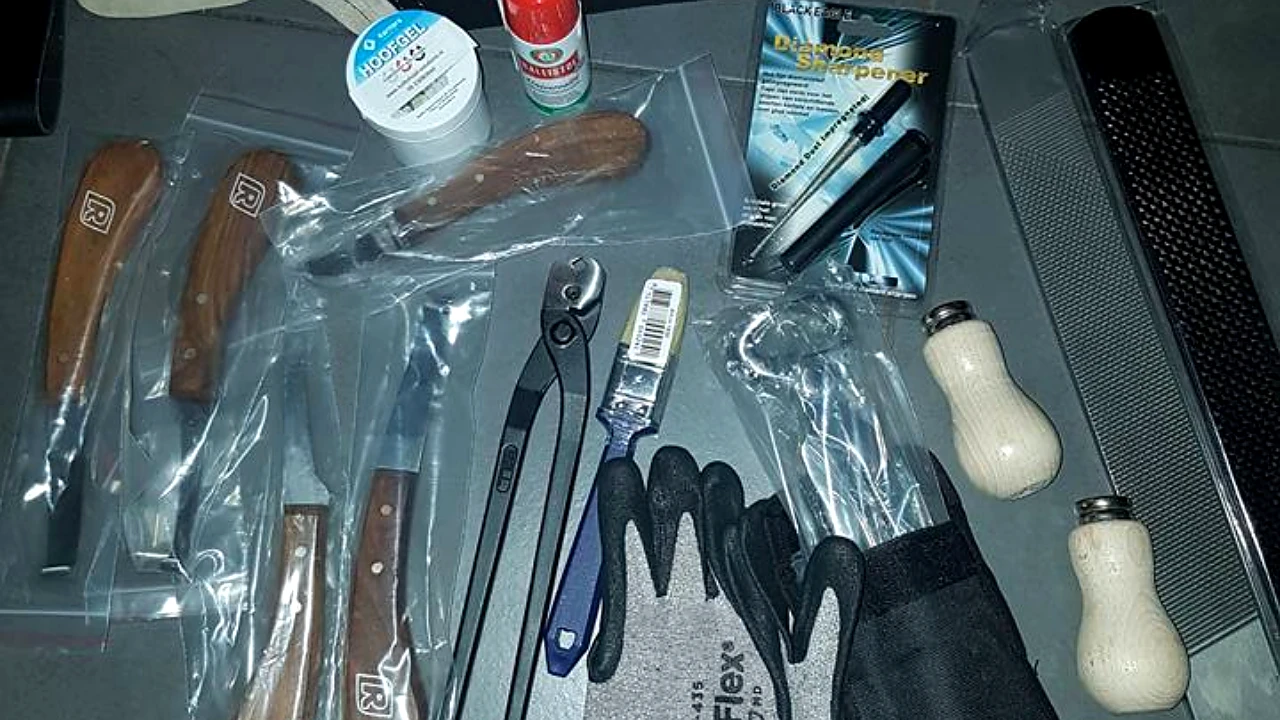
A farrier carries a surprisingly small number of tools, but each one does a specific job and quality makes a big difference. This farrier tools list groups the essentials by task, from cleaning the hoof to trimming, removing old shoes and fitting new ones. It explains what each tool is for and what to check before you buy or stock it. It is written for farriers, barefoot trimmers, horse owners and farrier supply shops.
1Tools for cleaning and checking the hoof
- Hoof pick: removes mud, stones and packed bedding from the sole and frog before any work starts. A pick with a brush cleans and sweeps in one tool.
- Hoof tester: large pincers that apply gentle, controlled pressure to find sore spots, bruises and abscesses.
- Hoof stand: supports the foot at a comfortable height while you rasp and finish, saving the farrier’s back.
2Tools for trimming
- Hoof knife: pares the sole and frog and cleans the collateral grooves. It comes in right-hand, left-hand, wide-blade and loop styles.
- Hoof nippers: cut away excess hoof wall quickly before rasping. They are sold by length, usually 10 to 15 inches, and longer handles give more leverage.
- Hoof rasp: levels the foot and smooths the wall. It has a coarse rasp side for removing horn and a finer file side for finishing.
- Rasp handle: gives a safe, comfortable grip and keeps the hand away from the teeth.
Our guides to choosing hoof nippers and the types of hoof knives go into more detail on these two key tools.
3Tools for removing shoes
- Clinch cutter (buffer): raises or cuts the clinches, the bent nail ends on the hoof wall, so the shoe can be removed without tearing the wall.
- Shoe puller (pull-off): levers the old shoe off the foot once the clinches are open.
- Crease nail puller: grips the nail heads in the crease of the shoe so individual nails can be drawn out, which protects the hoof wall.
4Tools for fitting and nailing shoes
- Driving hammer: a light hammer that drives horseshoe nails through the wall. Its claw wrings off the nail points afterwards.
- Clincher: bends the nail ends down neatly against the hoof wall to hold the shoe securely.
- Clinch block: sets the clinches tight before they are finished.
- Nail cutter: trims nail ends cleanly to length.
5Tools for shaping and forging shoes
- Anvil: the working surface for shaping shoes, with a flat face and a rounded horn.
- Rounding hammer: a heavier hammer used at the anvil to shape and level shoes.
- Forging tongs: hold hot shoes securely; longer tongs keep the hand further from the heat.
- Pritchel and punches: open and clean nail holes in the shoe.
- Forge: heats shoes for hot fitting and forging, usually gas-fired today.
6Protective gear and storage
- Farrier apron or chaps: leather protection for the legs against slipping knives, rasps and sharp clinches.
- Tool box or kit bag: keeps tools organised and protects cutting edges in transport.
- Safety glasses and gloves: protect against flying nail ends and sharp edges.
7What to look for when buying farrier tools
For cutting tools, the steel and heat treatment decide how long the edge lasts. Nippers should have jaws that meet evenly across their full width and a joint that moves smoothly with no side play. Hoof knives should arrive sharp, with a comfortable handle that suits the hand you cut with. Pullers and clinchers need strong, well-aligned jaws that grip without slipping. Buying tools that are forged rather than cast, and from a maker who checks every piece, saves money over the life of the tool.
Farrier supply shops and distributors should also look at range and consistency: the same model should look and perform the same in every carton. Private label options let you sell tools under your own brand.
Shop the essentials
- Hoof nippers: 10 to 15 inch, spring-loaded, race and half-round models.
- Hoof knives: right-hand, left-hand, loop and wide-blade knives.
- Hoof rasps and files: full-size, curved and mini rasps.
- Farrier tool kits: leather kit bags with the core trimming tools.
In short
- Cleaning and checking: hoof pick, hoof tester, hoof stand.
- Trimming: hoof knife, hoof nippers, hoof rasp and handle.
- Shoe removal: clinch cutter, shoe puller, crease nail puller.
- Nailing: driving hammer, clincher, clinch block, nail cutter.
- Forging: anvil, rounding hammer, tongs, pritchel and forge.
Frequently asked questions
What tools does a farrier use?
The core tools are a hoof pick, hoof knife, hoof nippers, rasp, clinch cutter, shoe puller, driving hammer and clincher, plus an anvil, rounding hammer, tongs and forge for shaping shoes.
What tools do I need to trim my own horse’s hooves?
For basic barefoot trimming you need a hoof pick, a hoof knife, a pair of hoof nippers and a rasp. Always learn from a qualified farrier or trimmer first.
What is the difference between a clinch cutter and a clincher?
A clinch cutter opens or cuts the clinches so an old shoe can come off. A clincher does the opposite: it bends new nail ends down to hold a new shoe in place.
Which farrier tool is used the most?
The rasp and the hoof knife are used on almost every horse, whether it is shod or barefoot, so they wear the fastest and are worth buying in good quality.
Can I buy farrier tools wholesale from Rekhi?
Yes. We manufacture farrier tools in Sialkot, Pakistan and supply farrier shops and distributors worldwide, with orders from one piece and private label options.
Stocking farrier tools for your shop?
We manufacture the full range of farrier tools for wholesale and private label orders, from one piece.